

Cold Formed Steel Framing Systems That Perform
Every schedule looks manageable until framing starts exposing what was never fully resolved. Missing dimensions, conflicting trades, vague load paths, and site labor variability can turn a clean set of drawings into a daily stream of RFIs and field fixes. That is where cold formed steel framing systems separate themselves - not just as a material choice, but as a project delivery strategy.
For commercial teams trying to protect schedule and budget, the real question is not whether cold-formed steel works. It does. The better question is how the framing system is designed, coordinated, produced, and installed. That is where outcomes change.
What Are You Actually Buying?
Too many projects still buy framing as if the scope begins and ends with steel studs and track. It does not. On a compressed project, raw material alone solves very little. If the framing package arrives without coordinated engineering, manufacturable details, and installation logic, the jobsite becomes the place where unresolved decisions get made under pressure.
A complete framing system is different. It starts in preconstruction, where plans are reviewed for constructability, structural logic, sequencing, and coordination risk. From there, the work moves into digital modeling, stamped engineering, and panelized production that matches the approved design intent. By the time components reach the site, the goal is simple: fewer decisions left for the field.
That distinction matters because field labor is expensive, inconsistent, and increasingly hard to secure. When crews are forced to interpret incomplete information, production slows and quality becomes dependent on who is available that week. A system-based approach reduces that exposure.
Why Cold Formed Steel Framing Systems Gain Ground
The market is not moving toward cold formed steel framing systems because they sound modern. It is moving there because the old way leaves too much risk unresolved until construction is already underway.
Developers want more predictable schedules. General contractors want fewer trade conflicts and less rework. Architects want their intent carried through without constant field improvisation. Owners want buildings delivered without the slow bleed of avoidable change. A well-executed cold-formed steel framing scope supports all of those priorities.
There are also practical advantages that continue to matter across multifamily, hospitality, student housing, senior living, and other commercial work. Steel offers dimensional consistency, noncombustible characteristics in many assemblies, and compatibility with panelized production. But material properties alone do not produce schedule savings. The gains come when those properties are paired with engineering discipline and manufacturing control.
The Real Value Is Upstream Coordination
The strongest framing packages solve problems before fabrication starts. That sounds obvious, but it is still where many projects fall apart. Plans may be permit-ready without being fabrication-ready. Structural intent may be sound without being installation-efficient. Trade zones may appear workable on paper while creating clashes in actual wall and floor assembly conditions.
This is why design assist and BIM coordination matter. They are not add-ons. They are the part of the process that determines whether the field receives a buildable scope or a stack of unresolved assumptions.
When framing is digitally coordinated early, teams can address opening conditions, truss loading, deflection strategy, panel breaks, bearing locations, and interface points with MEP systems before manufacturing begins. That reduces RFIs later because the major decisions have already been made by the right people, at the right time.
For GCs, that means fewer disruptions to sequence. For architects and engineers, it means fewer downstream clarifications. For owners, it means less budget volatility driven by late-stage correction.
Panelization Changes the Jobsite Equation
Factory-built wall panels and truss assemblies are often discussed as a speed play. That is true, but speed is only part of the story. The larger benefit is control.
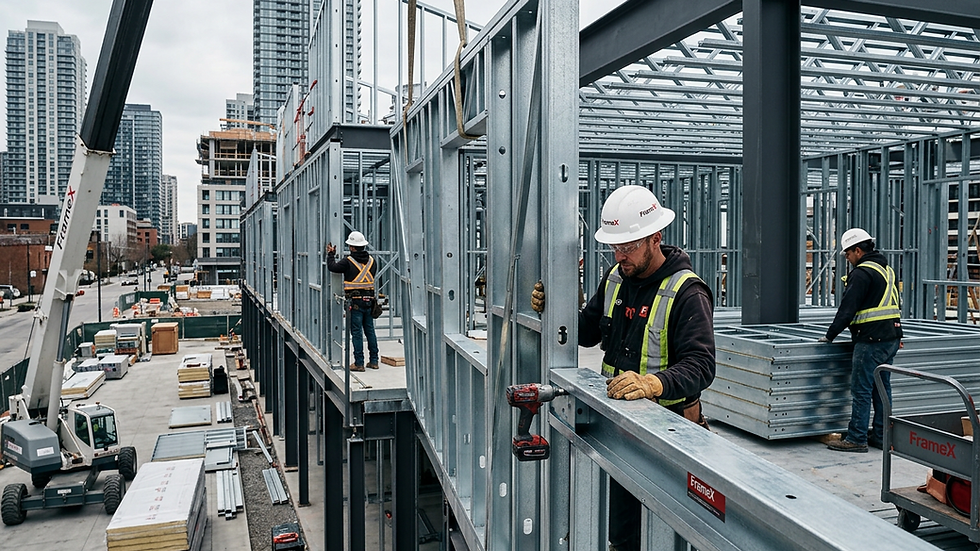
Panelized framing shifts labor from a variable site environment into a managed production environment. That allows tighter tolerances, repeatable quality, and better material use. It also reduces jobsite congestion. Instead of stick-building every condition in place, crews install pre-engineered components with a defined sequence.
That changes manpower planning. It changes crane planning. It changes how quickly floors can be turned over to follow-on trades. It also reduces the number of field cuts, field modifications, and improvised fixes that tend to erode both schedule and quality.
There is a trade-off, of course. Panelization requires earlier decisions. Teams have to commit to coordination sooner, and late architectural or structural changes become more disruptive once manufacturing is underway. But that is not a weakness of the system. It is a reflection of reality. Projects that want fabrication-level efficiency must be willing to make fabrication-level decisions on time.
Where Projects Win - and Where They Struggle
Cold-formed steel framing performs best when the project team understands that procurement is not just a buyout event. It is part of project planning.
Projects tend to win when framing partners are brought in early enough to review constructability, identify scope gaps, and align the engineering and production path with the master schedule. In those cases, framing becomes a coordinated package that supports the entire build.
Projects tend to struggle when the framing scope is treated like a commodity purchase. Budget may look sharper up front, but that number often ignores the costs that appear later - schedule drag, trade interference, labor inefficiency, and rework. Cheap material can become expensive execution.
This is especially true on projects with repetitive unit plans, aggressive turnover dates, and layered building systems. Multifamily and hospitality work are common examples. These buildings reward repeatable production and punish field uncertainty. A framing system built around digital coordination and controlled manufacturing is often a better fit than a field-heavy approach.
Choosing the Right Framing Partner
Not every provider of cold formed steel framing systems delivers the same thing. Some supply material. Some provide engineering. Some manufacture panels. Fewer integrate design review, stamped calculations, BIM coordination, manufacturing, and delivery into one workflow.
That gap matters because handoffs create risk. When design, engineering, fabrication, and installation planning are split across disconnected parties, information degrades. Scope questions sit longer. Responsibility blurs. The field ends up absorbing the difference.
A stronger model is one where the framing partner reviews the plans, identifies constructability concerns, coordinates the digital model, produces the engineered package, manufactures the components, and ships them according to the site sequence. That is how uncertainty gets reduced before it reaches the project.
Frame X Systems operates in that space. The value is not simply that steel shows up. The value is that the framing package is resolved as a system before it hits the site.
What Decision-Makers Should Ask Early
If you are evaluating framing options, the best questions are not limited to gauge, lead time, and price per square foot. Those matter, but they are incomplete.
Ask how the framing scope will be coordinated with the rest of the building. Ask when constructability review starts. Ask who owns the engineering. Ask whether the package is panelized, and if so, how site logistics and installation sequencing are planned. Ask what level of detail will be resolved before fabrication. Ask how changes are managed once production begins.
Those questions reveal whether you are buying components or buying execution control.
The answer should match the pressure profile of the job. A simple structure with ample schedule float may tolerate a more basic procurement path. A dense multifamily or hospitality build with labor constraints and hard turnover milestones usually cannot. In those environments, the framing strategy should actively remove risk, not just fulfill a material spec.
The Shift From Product to Process
The construction industry is steadily moving away from fragmented procurement on critical scopes. Framing is one of the clearest places to see that shift. As labor remains tight and schedules stay compressed, project teams need more certainty earlier.
That is why cold formed steel framing systems continue to gain traction. Not because steel is new, and not because panelization is trendy. They gain traction because they align design, engineering, manufacturing, and installation in a way that reduces field exposure.
The projects that benefit most are not simply choosing steel over another material. They are choosing a more controlled path to execution. That is a meaningful difference.
If the goal is fewer surprises, faster installation, and cleaner coordination, the framing conversation should start long before steel is ordered. The strongest jobs are usually the ones where the hard decisions were solved before anyone stepped onto the deck.


Comments