

What Is Cold Formed Metal Framing?
A project can look fully resolved on paper and still break down the moment framing starts. Trade conflicts appear. Wall depths shift. Openings miss. Labor stretches thin. That is usually when teams start asking what is cold formed metal framing, and whether it solves more than just the structural scope.
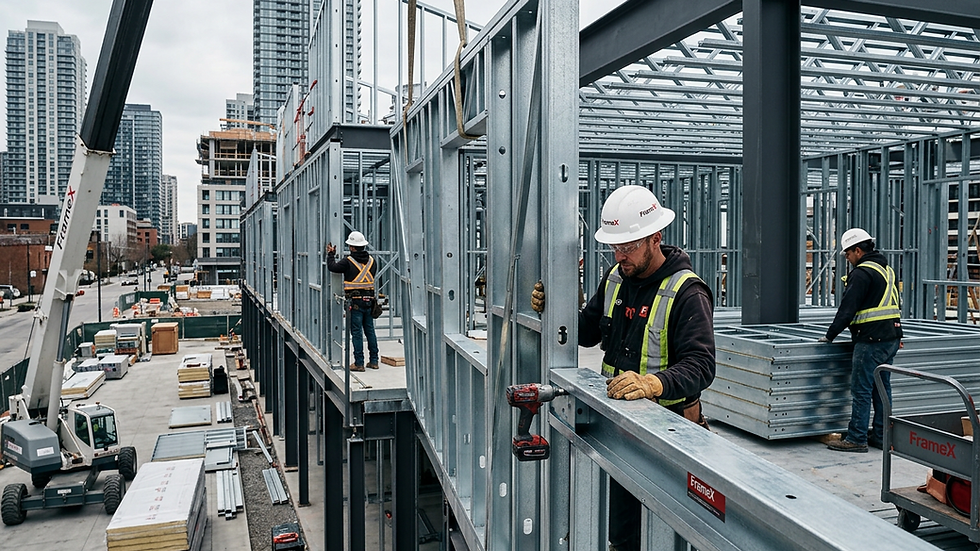
Cold formed metal framing is a building system made from thin steel sheets that are shaped at room temperature into structural and nonstructural framing members. Those members are then used to build interior walls, exterior wall panels, floor systems, roof trusses, curtain wall framing, and load-bearing assemblies across commercial and multifamily construction.
The basic idea is simple. Steel coil is formed into precise shapes such as studs, track, joists, headers, and truss components without heating the metal. The result is a lightweight, high-strength framing material that can be engineered for predictable performance. In practice, though, cold formed metal framing is not just about the steel profile itself. It is about how the system is designed, coordinated, fabricated, and installed.
What is cold formed metal framing used for?
Cold formed metal framing shows up in a wide range of project types because it gives teams flexibility without the weight and variability of heavier structural systems. In multifamily and hospitality work, it is commonly used for load-bearing wall panels, floor joists, and roof trusses. In commercial projects, it is often used for nonstructural interior partitions, exterior infill walls, and soffits.
The reason it fits so many building types is that it can handle both repetitive layouts and complex geometries. A straightforward apartment stack benefits from speed and consistency. A project with stepped elevations, varied openings, and tight MEP zones benefits from precision and coordination.
That distinction matters. Many teams think of cold formed framing as a material choice. It is more accurate to treat it as an execution strategy. If the framing package is engineered and coordinated early, it can remove a significant amount of field uncertainty before crews ever start installation.
How cold formed metal framing is made
The term cold formed refers to the manufacturing process. Steel is shaped into framing members by rolling or pressing it through dies at ambient temperature rather than hot rolling it at high heat. That process creates standardized profiles with consistent dimensions and material properties.
Because the members are formed with precision, engineers can design around exact section properties, load paths, and connection requirements. That predictability is one of the biggest advantages over field-built assemblies that rely heavily on interpretation after material arrives on site.
But the steel itself is only one part of the equation. On a well-run project, the framing system moves through design assist, engineering, BIM coordination, shop production, labeling, packaging, and staged delivery. If those steps are disconnected, cold formed framing can still create RFIs and rework. If they are integrated, it becomes a tool for schedule control.
Why commercial teams choose cold formed framing
Speed is usually the first reason, but not the only one. Cold formed steel components can be panelized and manufactured off site, which reduces on-site cutting, layout, and assembly time. That helps when labor is tight or the project is trying to recover schedule.
It also performs well from a coordination standpoint. Openings can be framed to exact dimensions. Wall assemblies can be modeled around structure, facade, and MEP systems before fabrication starts. That shifts decisions upstream, where they are cheaper to make.
There are durability and code advantages as well. Steel does not rot, warp, split, or support mold growth the way organic materials can under the wrong conditions. It is noncombustible, which can simplify certain code-driven design decisions depending on the project type and assembly requirements.
Cost is where the conversation gets more nuanced. Cold formed metal framing is not automatically the cheapest option on material price alone. It often becomes the better value when teams account for labor exposure, waste, field fixes, schedule pressure, and coordination risk. That is a different procurement mindset. You are not just buying studs and track. You are buying certainty in how the framing scope gets executed.
What is cold formed metal framing compared to wood or hot rolled steel?
Compared with wood framing, cold formed steel offers tighter dimensional consistency, better resistance to moisture-related movement, and stronger compatibility with prefabrication. On larger commercial jobs, those traits matter because even minor variation can multiply across hundreds of units or rooms.
Compared with hot rolled structural steel, cold formed framing is lighter and typically used for secondary structure, load-bearing walls, floor framing, and roof trusses rather than long-span primary framing. It is efficient, but it is not a universal substitute. The right system depends on span, loading, lateral design, building height, and the overall structural concept.
That is why early design coordination matters. Teams get into trouble when cold formed framing is treated as a late-stage commodity instead of a system that needs engineering and interface resolution. The framing may be capable. The project still fails if connections, tolerances, deflection criteria, and trade clearances are not resolved in advance.
Where projects succeed or fail with cold formed framing
The biggest misconception is that cold formed framing reduces field issues by default. It can, but only if the package is actually coordinated. Raw material dropped on a jobsite still leaves the field team to figure out sequencing, dimensions, conflicts, and interpretation under pressure.
That is where the delivery model matters more than many buyers realize. There is a meaningful difference between purchasing steel members and purchasing a complete framing system. A complete system includes design review, engineering, digital coordination, fabrication logic, and installation-ready output. It is solved before it hits the jobsite.
When that process is missing, familiar problems follow. Window openings conflict with structure. Mechanical runs force wall revisions. Truss bearing conditions get clarified late. Crews burn time sorting bundles and rebuilding assemblies. The framing scope becomes a source of schedule drag instead of schedule gain.
When the process is disciplined, the opposite happens. Panels arrive labeled, sequenced, and aligned to coordinated drawings. Installers spend less time measuring and correcting. General contractors get fewer surprises. Owners get better schedule protection.
What project teams should evaluate before specifying it
If you are considering cold formed metal framing, the first question is not whether steel works. The first question is how the framing scope will be delivered.
Start with project type and repeatability. Multifamily, student housing, senior living, hospitality, and similar mid-rise or low-rise commercial projects often gain the most when layouts repeat and schedule compression is real. Then look at complexity. The more facade variation, MEP density, and structural interface points involved, the more value there is in solving the framing package upstream.
Also evaluate who owns coordination. If the framing provider is only shipping material, your field team may still carry the burden of interpretation. If the provider is delivering engineered wall and truss panel systems with preconstruction review and BIM coordination, the risk profile changes.
Finally, look at logistics. Prefabricated framing works best when manufacturing, packaging, and delivery are aligned with site access, crane planning, and installation sequencing. Off-site production is powerful, but only when tied to the actual jobsite plan.
The real value of cold formed metal framing
At its best, cold formed metal framing brings discipline to one of the most coordination-sensitive scopes in the building. It creates a path to lighter structures, faster enclosure, cleaner interior layout, and more predictable installation. But the real payoff is not theoretical efficiency. It is fewer decisions made under field pressure.
That is why sophisticated project teams are moving beyond material procurement and toward fully coordinated framing systems. Companies like Frame X Systems are built around that shift - combining design assist, engineering, BIM coordination, panelized manufacturing, and installation-ready delivery into one workflow. For developers, general contractors, architects, and owners, that means less uncertainty between drawing issue and field execution.
If you are asking what is cold formed metal framing, the shortest answer is this: it is steel framing shaped without heat and engineered for modern construction. The better answer is that, when delivered correctly, it is a way to control risk before the first bundle or panel reaches the site. That is where schedules get protected, crews stay productive, and projects stop paying for problems that could have been solved earlier.


Comments