

Constructability Review for Framing That Works
A framing package can look complete on paper and still fail the moment crews start laying out walls, opening shafts, or coordinating embeds. That is where a constructability review for framing earns its value. It tests whether the framing system can actually be built as designed, in sequence, and without forcing the field to solve preventable problems under schedule pressure.
For commercial teams, this is not a paperwork exercise. It is a risk-control step that sits between design intent and jobsite execution. When it is done early and done well, it reduces RFIs, compresses decision cycles, limits trade interference, and gives procurement and operations a clearer path forward.
What a constructability review for framing actually does
At its core, a constructability review for framing asks a direct question: will this framing system install cleanly in the real conditions of the project? That means more than checking member sizes or code compliance. It means reviewing geometry, load paths, attachment conditions, tolerances, sequencing, delegated design scope, and the interaction between framing and every major adjacent trade.
On a multifamily or hospitality project, that often includes wall panel layouts, floor line transitions, truss bearing conditions, curtain wall support, exterior sheathing requirements, MEP penetrations, head-of-wall conditions, deflection strategy, and how framing interfaces with concrete, structural steel, podiums, and prefabricated assemblies. If those decisions are still loose when fabrication starts, the jobsite inherits the uncertainty.
That is the expensive version of framing.
A strong review turns a framing scope from a material buy into an execution plan. It clarifies what is standard, what is custom, what needs engineering resolution, and what will cause installation friction if left untouched.
Why framing issues surface late when nobody owns coordination
Framing sits in the middle of everything. It touches structure, envelope, drywall, MEP, firestopping, openings, and finishes. Yet on many projects, it is still purchased too late and treated too narrowly. The result is predictable: design documents carry reasonable intent, but critical installation logic is still missing.
The problem is not usually a single bad detail. It is the accumulation of small disconnects. A wall type may work structurally but ignore the real routing space required above a corridor ceiling. A truss profile may satisfy loads but create conflicts with duct mains or plumbing drops. A shaft wall may be drawn correctly in elevation but leave no practical way to frame and brace it in sequence. Each issue by itself looks manageable. Together, they generate lost time, field modifications, and change exposure.
This is why constructability has to be reviewed as a system, not as isolated details.
The highest-value checks in framing coordination
The most effective reviews focus on where schedule and cost risk actually live. Connection assumptions are one example. If backing structure, embed locations, slab edge conditions, or attachment tolerances are unclear, installation slows immediately. The same goes for dimensional consistency. Repetitive wall panels only create speed if floor-to-floor heights, opening logic, and interface conditions are resolved enough to support repeatable manufacturing.
Trade space is another major pressure point. Framing rarely fails because steel cannot be fabricated. It fails because the framed condition does not leave room for the other work that has to happen in and around it. Mechanical distribution, risers, electrical pathways, fireproofing, and envelope support all need physical space. If that space is not coordinated upstream, the field starts negotiating with a fixed condition.
Sequencing matters just as much. Some framing details are technically correct but operationally inefficient. They require excessive temporary bracing, out-of-order installation, or late access after adjacent trades have already occupied the area. A constructability review should catch those conditions before they become schedule traps.
What gets missed when framing is bought as raw material
When teams buy framing as a commodity, they usually end up buying uncertainty with it. Raw material supply does not resolve delegated design assumptions. It does not coordinate framing zones against MEP models. It does not rationalize panel breaks for shipping and installation. It does not address field tolerance stacking or identify where standard details break down.
That gap shows up in familiar ways: more RFIs, more hand sketching in the field, more last-minute engineering requests, more labor standing while teams wait for direction. None of that is surprising. The project simply deferred decision-making until the most expensive point in the process.
A complete framing system approach changes that equation. Instead of asking the field to interpret the design, it resolves the framing package before production. Design assist, engineering, BIM coordination, panelization strategy, and installation logic are developed together. That is how fewer decisions reach the jobsite in the first place.
Constructability review for framing in panelized projects
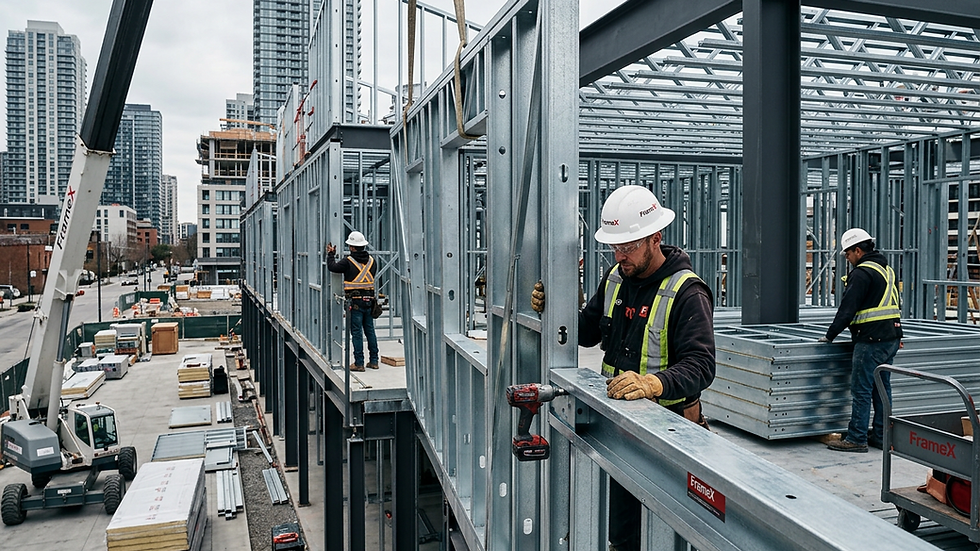
Panelized cold-formed steel magnifies the value of good preconstruction and the cost of bad assumptions. Panelization can accelerate schedule and reduce labor exposure, but only when the design is coordinated to a fabrication-ready level. If not, the shop gets pushed into rework, shipping plans become unstable, and the installation sequence loses its advantage.
This is where constructability review becomes more disciplined, not less. Teams need to confirm panel sizes against transport constraints, crane or telehandler access, site storage limitations, and hoisting sequence. They need to evaluate repeatability, identify exception conditions, and standardize wherever the building allows. They also need to verify that field crews can actually set, align, and connect the system as intended.
Well-run panelized framing does not remove complexity. It relocates complexity to a place where it can be solved with more control.
When to start the review
Earlier is better, but timing depends on the project. In most cases, the review should begin while the design still has enough flexibility to absorb adjustments without triggering redesign across the whole set. Waiting until permit drawings are complete or procurement is already underway limits the value. By then, teams are often trying to preserve schedule by pushing known issues downstream.
The right point is usually during design development or early construction documents, when major wall types, structural assumptions, and architectural intent are established but detailing can still be refined. At that stage, a framing partner can identify scope gaps, structural sensitivities, repetitive opportunities, and likely trade conflicts before they become procurement or field problems.
For schedule-driven work such as multifamily, student housing, and hospitality, this early review can be the difference between a factory-built framing package that installs predictably and a project that spends weeks chasing revisions and workarounds.
What decision-makers should expect from the process
A useful constructability review for framing should produce more than marked-up plans. It should give the project team clear direction. That includes identified conflicts, recommended adjustments, engineering considerations, assumptions that need owner or design team confirmation, and a practical path to production.
Just as important, it should separate issues by consequence. Some comments affect structural performance. Others affect fabrication efficiency, installation speed, or trade access. Not every clash carries the same cost, and not every design preference should survive if it creates avoidable execution risk. Experienced teams know how to sort those priorities.
This is also where accountability matters. If the same partner handling constructability is also responsible for engineering coordination, manufacturing strategy, and delivery logic, the review becomes more useful. Recommendations are tied to how the system will actually be built, shipped, and installed. That is a different level of control than a review performed in isolation.
Why this matters more in the current labor environment
Labor pressure has changed the economics of field problem-solving. A jobsite with thin manpower and compressed durations cannot absorb the same level of ambiguity that projects tolerated years ago. Every unresolved framing question costs more because experienced labor is harder to replace, supervision bandwidth is tighter, and schedule recovery is more expensive.
That is one reason firms are shifting upstream. They are not looking for more theory. They are looking for fewer field variables. A disciplined constructability review supports that goal because it reduces dependence on improvisation. It creates a cleaner handoff from design to production to installation.
For teams using a system-based provider such as Frame X Systems, that upstream control is the point. The value is not in steel alone. It is in receiving a framing package that has already been tested against the job the field is about to perform.
A good building team does not wait for framing problems to announce themselves from a lift or a stair core. It asks harder questions earlier, resolves what can be resolved, and sends a cleaner package to the site. That is how schedule gets protected before installation starts.


Comments