

Construction Labor Shortage Solutions That Work
A framing crew cannot install clarity that was never created in preconstruction. That is the central issue behind effective construction labor shortage solutions: the industry does not simply need more people on site. It needs less unresolved work waiting for the people who are available.
For commercial builders, labor pressure shows up as missed production targets, rising subcontractor bids, extended supervision demands, and schedules that become vulnerable to one delayed trade. Hiring and retention matter, but they are long-term workforce challenges. A project team needs execution strategies that protect the current schedule now.
The strongest response is to move labor-intensive decision-making upstream. Resolve the framing system before materials arrive, reduce the number of field cuts and judgment calls, and deliver work in assemblies that crews can install with a clear sequence.
Why the Labor Shortage Hits Framing So Hard
Traditional framing workflows place a large share of coordination on the jobsite. Plans may establish design intent, but the field team is often left to reconcile structural requirements, architectural conditions, MEP penetrations, opening locations, backing, deflection details, and actual site dimensions. When those questions surface late, skilled labor becomes the buffer.
That is expensive labor to use as a problem-solving tool. A foreman who is walking the site with drawings, waiting on an RFI, or directing rework is not producing installed square footage. Neither is a crew that has to sort loose materials, correct mislabeled components, or build around conflicts that should have been identified during coordination.
The labor shortage magnifies every weakness in this process. When experienced installers are scarce, projects have less capacity to absorb learning curves, field improvisation, and trade interference. A system that depends on heroic field execution is no longer a reliable system.
Construction Labor Shortage Solutions Begin in Preconstruction
The most practical way to reduce labor exposure is to remove avoidable work from the field. This does not mean eliminating skilled crews. It means reserving their time for installation, verification, and quality control rather than asking them to engineer solutions under schedule pressure.
A coordinated framing package begins with constructability review. Architectural, structural, and MEP information must be examined as one buildable condition, not as separate drawing sets passed downstream. Wall types, truss geometry, load paths, openings, headers, connections, fire and acoustic requirements, and service penetrations need resolution before production.
BIM coordination is valuable because it exposes conflicts while they are still digital and inexpensive to address. A clash found in coordination may require a conversation. The same clash found after framing begins can require an RFI, a redesign, material changes, remobilization, and lost work by multiple trades.
This is where project teams should ask a direct question: what work is the field crew still expected to figure out? If the answer includes layout interpretation, component selection, connection decisions, or recurring modification of standard details, the project is carrying unnecessary labor risk.
Shift Work From Field Assembly to Controlled Production
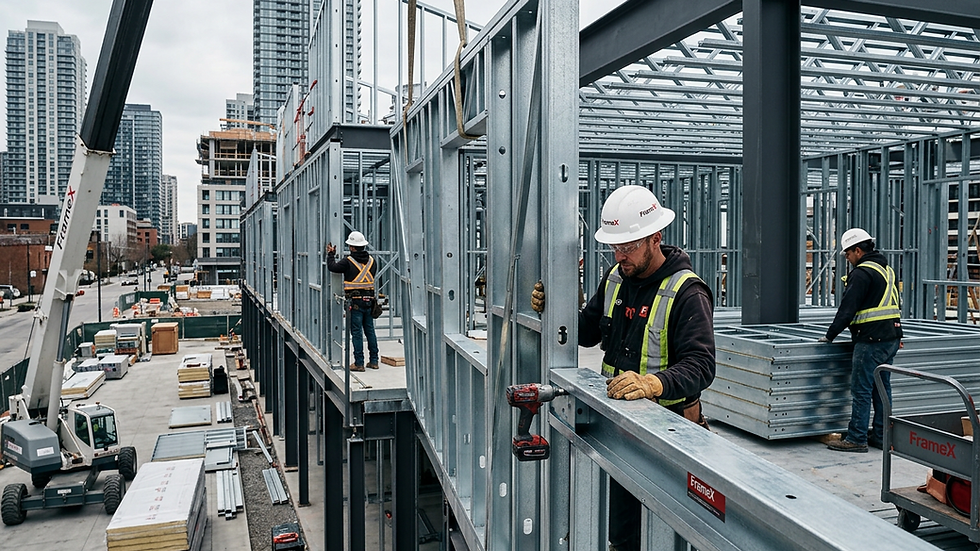
Panelization changes the labor equation by transferring repeatable assembly tasks into a controlled manufacturing environment. Rather than shipping raw steel and asking crews to build walls stick by stick, an engineered system can deliver labeled wall panels and truss components prepared for their installation sequence.
The benefit is not only speed. Factory production improves consistency. Components are built from coordinated documents, using defined tolerances and repeatable processes. Crews receive larger, more complete assemblies and spend less time measuring, cutting, sorting, and correcting.
That distinction matters on multifamily, hospitality, student housing, senior living, and other projects with repetition. Repetition is where production systems create the greatest advantage. A field crew can move from building each wall individually to setting planned assemblies within a coordinated layout.
Panelization is not the right answer for every condition. Highly fragmented renovations, projects with limited access, or designs with constantly changing dimensions may require a more selective approach. But even on those projects, engineered componentization and early coordination can reduce the amount of problem-solving left to the field.
Design for Installation, Not Just for Approval
A stamped structural package is necessary, but it is not automatically installation-ready. The difference is whether the documents account for how the system will be built, sequenced, connected, and coordinated with adjacent trades.
Installation-ready design considers practical questions: Can the panel be delivered and lifted safely? Where will trusses bear? How do wall assemblies accommodate deflection? Are connection details consistent across similar conditions? Is backing fully identified before drywall, millwork, and equipment requirements become field changes? Have MEP pathways been coordinated so installers are not cutting through framing after the fact?
These questions should be addressed during design assist, not saved for a kickoff meeting after procurement. When architects, engineers, general contractors, and framing partners work through constructability early, the result is more than better drawings. It is a clearer production plan.
A design that looks efficient on paper but requires constant exceptions in the field will consume labor at the worst possible time. By contrast, a system designed around installation can help a smaller crew maintain predictable output.
Make Labor Productivity Measurable
Labor shortages can create vague conversations: crews are short, production is slow, and costs are rising. Project teams need a more operational view. Track the sources of lost production and determine whether each one is a labor-capacity problem or a planning problem.
Useful indicators include installed square footage per crew day, RFI volume tied to framing, field modifications per floor or area, rework hours, waiting time for materials, and the number of trade conflicts discovered after installation begins. None of these metrics tells the whole story alone. Together, they reveal whether the framing scope is arriving ready to install.
This approach also improves procurement decisions. The lowest material quote can become the highest installed cost if it transfers coordination, sorting, field fabrication, and correction back to the contractor. What are you buying? Not steel. Not materials. A complete framing system that reduces the work required to turn those materials into a finished structure.
Build a More Reliable Site Sequence
Labor productivity is closely tied to sequence. A crew can only perform when access, layout, materials, lifting equipment, and preceding work are ready. When any one of those inputs fails, available labor is consumed without creating progress.
Coordinated delivery matters because it keeps panels and trusses aligned with installation priorities. Sending all material at once can create handling congestion, damaged components, and time spent searching for what is needed next. Delivering by floor, zone, or sequence can reduce staging demands and keep crews focused on installation.
General contractors should also protect the framing crew from avoidable interruptions. Confirm slab and structural tolerances early. Establish responsibility for layout control. Coordinate access with MEP rough-in and other trades. Make field verification part of the process before a discrepancy becomes installed work.
The goal is not to create a rigid plan that cannot adapt. Construction always requires adjustment. The goal is to prevent routine conditions from becoming daily emergencies.
Use Skilled Labor Where It Creates the Most Value
The industry will continue to need capable installers, foremen, superintendents, and trade partners. The right response to labor scarcity is not to treat people as interchangeable. It is to stop wasting skilled time on work that can be engineered, coordinated, manufactured, or verified earlier.
That shift can also make crews more effective and easier to retain. Professionals are more likely to stay productive on projects where materials arrive correctly, details are clear, and the job does not require constant recovery from preventable failures. Better planning supports better field conditions.
For teams evaluating construction labor shortage solutions, the decision should come back to risk ownership. If unresolved framing questions remain in the field, the schedule is relying on labor capacity that may not exist. If those questions are resolved through design assist, engineering, coordination, and panelized production, the project gains control before the first crew arrives.
Frame X Systems approaches cold-formed steel framing as that complete execution strategy: a coordinated, engineered, installation-ready system built to reduce uncertainty before it reaches the jobsite. The most dependable labor plan is not the one that assumes more workers will appear. It is the one that gives the workers you have a job they can install correctly the first time.


Comments