

Can Panelized Framing Reduce Schedule Risk?
A framing package can arrive on time and still put the schedule at risk. If the field crew is sorting materials, resolving missing dimensions, waiting on engineering answers, or working around clashes discovered after delivery, the critical path is already exposed. So, can panelized framing reduce schedule risk? Yes, when it is delivered as a fully coordinated building system rather than a collection of prefabricated parts.
For commercial teams managing multifamily, hospitality, student housing, senior living, and other schedule-driven projects, the value is not simply faster installation. The value is moving decisions out of the field, where every unresolved issue costs more time and creates more downstream disruption.
How Panelized Framing Reduces Schedule Risk
Panelized framing changes when and where framing problems get solved. Traditional stick framing and material-only cold-formed steel procurement leave significant interpretation to the jobsite. Crews may receive raw steel, shop drawings, and a sequence of field decisions that depend on labor availability, site conditions, and coordination with other trades.
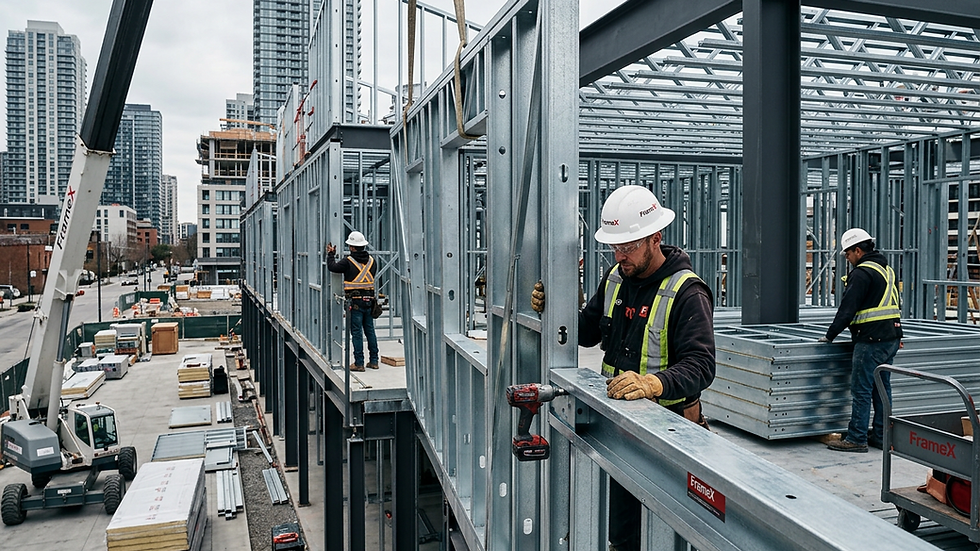
A panelized approach shifts that work upstream. Wall panels and truss systems are designed, engineered, digitally coordinated, manufactured, labeled, and staged for installation before they reach the project. That does not remove every construction variable. It does reduce the number of variables that must be managed under jobsite pressure.
The schedule benefit comes from control. Design intent is translated into installable components before crews mobilize. Structural requirements are resolved before fabrication. Openings, connections, bearing conditions, and interfaces are reviewed in coordination rather than discovered while a lift is waiting.
That distinction matters. Faster production in a factory has limited value if the system arrives with unresolved conflicts. A reliable schedule is built on fewer field decisions, not just more pieces produced offsite.
Coordination happens before crews are exposed
The most expensive framing question is often the one asked after installation has started: Does this opening match the current architectural set? Does the structure support the revised loading? Where does the MEP routing pass through this wall? Has the soffit condition changed since the last issue?
When these questions surface in the field, they generate pauses, RFIs, rework, and trade interference. The direct delay may be measured in hours or days, but the larger impact can spread through drywall, MEP rough-in, exterior enclosure, inspections, and finish work.
A coordinated panelized system creates an opportunity to identify those conditions during preconstruction. BIM coordination, constructability review, and engineering review allow the project team to resolve high-consequence details when changes are still relatively controlled. The goal is not to eliminate coordination from construction. The goal is to complete the framing-specific coordination before it can interrupt installation.
Factory production makes installation more predictable
Field framing depends heavily on crew productivity, material handling, weather exposure, laydown conditions, and daily access constraints. Those realities do not disappear with panelized construction, but their impact is reduced when a larger portion of framing labor is transferred to a controlled production environment.
Factory-built panels are produced to approved drawings using repeatable processes, then bundled and labeled for shipment and installation. Crews receive components intended for specific locations and sequences instead of building each wall from individual studs, track, clips, and accessories on site.
This improves predictability in two ways. First, it reduces the amount of cutting, measuring, staging, and assembly required in the field. Second, it gives the superintendent a clearer installation plan. A crew can focus on setting, fastening, bracing, and progressing through a defined area instead of continuously converting material into assemblies.
The schedule gain is especially meaningful where site labor is tight. Skilled framing labor remains a constraint in many markets. A system that requires fewer labor hours in the field can help protect production targets when staffing is less certain than the bid assumed.
Sequenced delivery protects the jobsite
Panelized framing is not a schedule solution if the jobsite cannot receive, stage, and install it efficiently. Delivery timing matters as much as fabrication timing.
A complete framing system should be planned around the construction sequence, crane or forklift access, available laydown space, floor loading, and installation priorities. Sending every panel at once can create congestion. Sending components without regard to erection sequence can force crews to move material repeatedly or search for what they need.
The strongest results come from planned release schedules. Panels, trusses, connection materials, and supporting documentation should arrive in a sequence that supports installation without overwhelming the site. This is particularly important on urban infill projects, occupied campuses, and constrained multifamily sites where storage space is limited and logistics are tightly managed.
What Panelization Cannot Solve by Itself
Panelized framing is not a substitute for a coordinated project team. It cannot correct an incomplete design if the design is released for fabrication before key decisions are made. It also cannot overcome late owner changes, permit delays, unprepared slabs, access restrictions, or trade work that is behind schedule.
The approach works best when the general contractor, architect, structural engineer, framing partner, and key trades align early on the information required for release. That includes current design documents, clear responsibility for approvals, defined tolerances, and a realistic sequence for production and installation.
There is also a planning trade-off. A highly coordinated panel package requires earlier commitment than buying raw material as the project unfolds. Teams gain schedule certainty by making decisions earlier. If a project has a fluid unit mix, unresolved façade design, or frequent late-stage architectural revisions, the team needs a release strategy that protects flexibility while avoiding fabrication of work that may change.
That is why design assist and constructability review are not add-ons. They are the risk-control work that makes panelization perform. The objective is to identify what is ready to lock, what must remain flexible, and what decisions will affect fabrication dates.
Where Schedule Risk Is Most Likely to Drop
Panelized framing tends to create the greatest schedule advantage on repetitive, multi-story, or labor-intensive scopes. Multifamily projects with recurring unit layouts can benefit from repeatable panel configurations and a steady installation rhythm. Hospitality, student housing, and senior living projects often have similar advantages because room types and corridor conditions repeat across floors.
Projects with aggressive turnover dates also benefit. When enclosure, rough-in, and finishes are closely linked to framing completion, a lost week in the framing sequence can threaten multiple follow-on activities. Reducing uncertainty at the framing stage protects more than the framing schedule. It protects the handoffs that follow.
Complexity is another factor. Projects with many openings, heavy header requirements, irregular geometry, transfer conditions, or dense MEP interfaces may require more preconstruction effort. Yet that is often exactly where a coordinated system has the greatest value. Complexity does not disappear, but it can be handled in design, engineering, and manufacturing rather than handed to the field as an open question.
A Better Question Than “Are Panels Faster?”
Project teams often ask whether panels install faster than field-built framing. That is a reasonable question, but it is too narrow. A more useful question is: how much uncertainty is still embedded in the framing scope?
If the answer includes incomplete coordination, unclear structural details, undefined penetrations, inconsistent drawing sets, or materials arriving without an installation plan, the schedule is vulnerable regardless of the framing method. Panelized framing becomes valuable when it reduces those unresolved conditions before they reach the site.
Frame X Systems approaches this as a complete framing system: architect-led design assist, constructability review, digital coordination, stamped structural packages, factory-built panels, and planned delivery. The product is not raw steel. It is a resolved scope that gives the field a clearer path to install.
Can Panelized Framing Reduce Schedule Risk on Your Project?
Yes, provided the panelized scope is engineered, coordinated, released at the right time, and delivered to match the installation sequence. The schedule improvement is not automatic. It is earned through preconstruction discipline.
For owners and project teams, that changes the procurement conversation. The lowest material price does not necessarily represent the lowest schedule exposure. A framing partner should be evaluated on its ability to resolve conditions early, produce installation-ready components, and support a reliable handoff from design to field execution.
The best time to protect the framing schedule is before the first stud arrives. Resolve the work while changes are still manageable, then send the field a system built to move.


Comments